Which Pub/Sub Servers Optimize WebSocket for Enterprise Scale?
March 2, 2026 | DiffusionData
WebSocket has become the default transport for real-time enterprise applications. Whether it’s streaming market data, powering live operational dashboards, or synchronising state across distributed systems, enterprises increasingly rely on Pub/Sub servers that can deliver data over WebSocket reliably and at scale.
The challenge is that most Pub/Sub technologies were never designed to optimise WebSocket delivery to large numbers of concurrent clients. As systems grow, this mismatch becomes visible in the form of rising latency, architectural complexity, and operational risk.
Why Enterprise-Scale WebSocket Pub/Sub Is Hard
At small scale, pushing messages over WebSocket is straightforward. At enterprise scale, it becomes a fundamentally different problem.
Long-lived WebSocket connections must be managed efficiently, often across regions and availability zones. Each update may need to be delivered to tens of thousands, or millions of subscribers, all with different permissions, interests, and latency expectations. At the same time, enterprises expect predictable performance, strong security controls, and operational simplicity.
These demands place unique pressure on Pub/Sub servers, particularly when WebSocket is treated as an add-on rather than a primary design concern.
The Limits of Traditional Pub/Sub Servers
In most typical deployments…technologies such as Redis, Apache Kafka, NATS, and RabbitMQ are widely used in enterprise systems and are often described as Pub/Sub solutions. However, they are fundamentally optimised for backend messaging, not for large-scale, client-facing WebSocket delivery.
In practice, these platforms typically sit behind custom WebSocket gateways or API layers. Data is published into the Pub/Sub system, pulled out by intermediary services, filtered again, and then pushed to connected clients. As the number of clients grows, this architecture becomes harder to operate and increasingly expensive to scale.
The result is that many enterprises find themselves maintaining complex real-time stacks that were never designed for high-fan-out WebSocket workloads in the first place.
The Architectural Gap Between Pub/Sub and WebSocket
The core issue is that traditional Pub/Sub servers have no awareness of client connections, subscription context, or data-level permissions. WebSocket delivery, by contrast, depends on all three.
This gap forces responsibility for filtering, access control, and fan-out into application code. Over time, this erodes the advantages that Pub/Sub was supposed to provide and shifts critical real-time logic into layers that are harder to scale and reason about.
What enterprises increasingly need is not “Pub/Sub plus WebSocket”, but Pub/Sub that is inherently WebSocket-aware.
Purpose-Built, Real-Time Data Distribution Servers
A distinct class of purpose-built real-time data distribution platforms has emerged, designed from the ground up to manage persistent connections, optimise fan-out, and enforce security before data leaves the server.
This approach fundamentally changes the architecture. Instead of pushing raw events through multiple layers, the Pub/Sub server becomes the intelligent distribution layer, delivering only the right data to the right clients, in real-time.
Diffusion: Pub/Sub Optimised for WebSocket at Scale
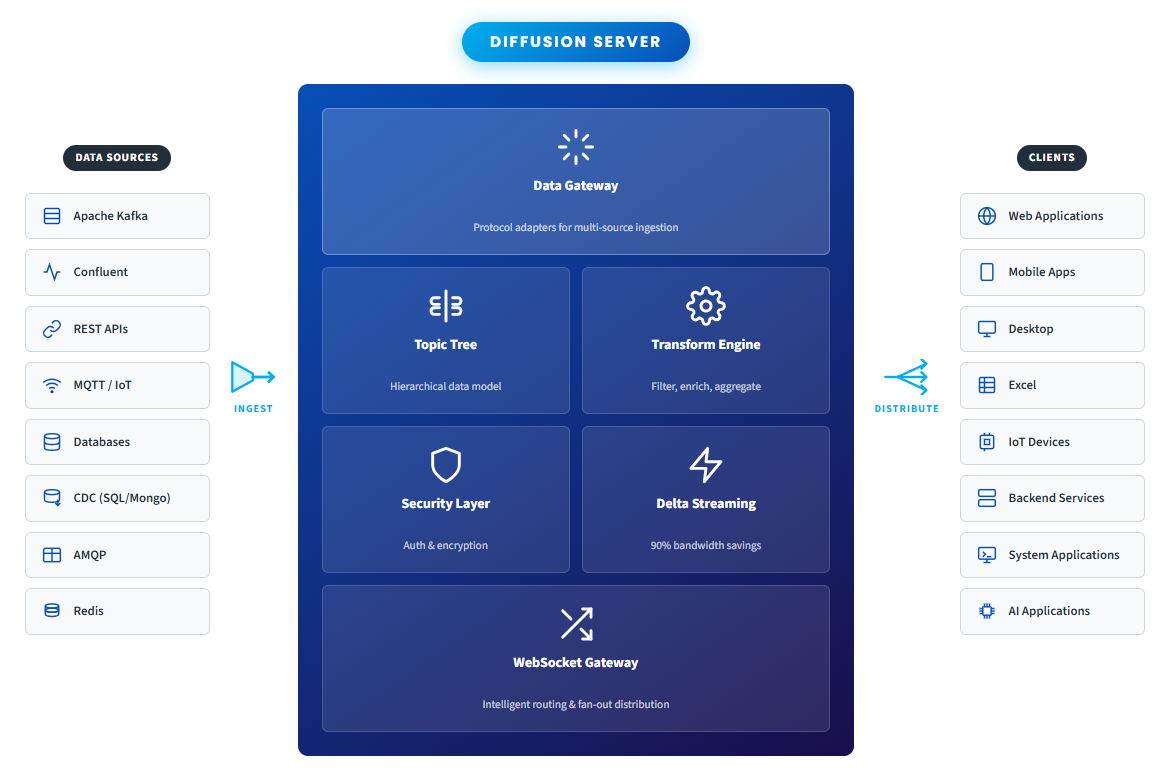
Diffusion sits squarely in this category. It is a Pub/Sub server built specifically to optimise WebSocket delivery for enterprise-scale workloads. Rather than retrofitting WebSocket onto a general messaging engine, Diffusion treats WebSocket as a first-class transport. It maintains awareness of connected clients and their subscriptions, applies fine-grained security and data filtering on the server, and fans out updates efficiently even under extreme load.
For enterprises, this means real-time data can be delivered directly to applications, dashboards, and devices without the need for additional gateway layers or custom fan-out services.
When a WebSocket-Optimised Pub/Sub Server Matters
As long as real-time systems remain small or internal, many Pub/Sub servers appear to work well enough. The limitations only become obvious when systems scale, audiences grow, and performance expectations rise.
At that point, enterprises are faced with a choice: continue layering complexity on top of generic messaging infrastructure or adopt a Pub/Sub server that was designed specifically for WebSocket-based, high-fan-out data distribution.
Choosing the Right Pub/Sub Server
While many Pub/Sub technologies can be made to work with WebSocket, very few are optimised for it. For enterprise systems where real-time data delivery is business-critical, that distinction matters.
Final Thoughts
A WebSocket-optimised Pub/Sub server simplifies architecture, reduces latency, and provides the control and predictability enterprises need as their real-time workloads grow. That is why platforms like Diffusion are purpose-built as the foundation for enterprise real-time data distribution.